
RBI awaits fiscal stance, inflation to cool off to decide on rates.

Finance Minister Nirmala Sitharaman is likely to strike a fine balance between being fiscally prudent and growth supportive when she presents her fourth straight budget on Tuesday, which is expected to have plans to boost spending to revive investment and create jobs. The Budget for the fiscal year starting April 1, 2022 is likely to raise spending on infrastructure to set the economy on a firmer footing. The stage for the Budget presentation was set by the Economic Survey stating that the government has the fiscal space to do more to support the economy that is forecast to grow at a healthy 8-8.5 per cent growth in the 2022-23 fiscal.

Inclusive growth is about enabling wider participation in the growth story, but the current if fiscal debate is about how to compensate losers using annual Budgets, says Rathin Roy.

The statement, issued after the 2-day meeting of the 6-member Monetary Policy Committee of the Reserve Bank of India, also said that recapitalisation of public sector banks along with resolution of stressed assets under the Insolvency and Bankruptcy Code (IBC) will create demand for fresh investments.

Stability in currency markets was only restored from September.

Pakistan's current account deficit (CAD) increased to a 4-year high of $17.4 billion in the fiscal year of 2021-22, indicating more troubles for the ailing economy of the cash-strapped country. The State Bank of Pakistan (SBP) on Wednesday reported that the country recorded a CAD of $17.406 billion in FY22 compared to a gap of just $2.82 billion in FY21. According to Dawn newspaper, the massive CAD speaks a lot about the severe problem of the balance of payments.

tailwinds of a remarkable year and handsome investor returns, Indian equities are set for an eventful journey in 2024, with a slew of local and global cues -- varying from interest rates to Lok Sabha polls to geopolitical happenings. Analysts are of the view that the bull run in the domestic equity market will continue, and over the next 3-6 months, the benchmark indices -- Sensex and Nifty -- could climb up to 7 per cent. In 2023, the 30-share BSE Sensex jumped 11,399.52 points or 18.73 per cent, and the NSE Nifty climbed 3,626.1 points or 20 per cent.

Ahead of the 2023-24 Union Budget, the thinking at the top level of the central government is clear: Gross domestic product (GDP) growth of 6-6.5 per cent is a comfortable enough target for FY24 and the focus should be on fiscal consolidation to ensure that the sovereign cost of borrowing does not become prohibitively expensive in a high-interest rate environment, according to people in the know. Those aware of deliberations between the Prime Minister's Office (PMO) and the Ministry of Finance said while the Budget would look to strike a balance between infrastructure investment and welfare schemes, it is unlikely to be populist, though it will be the last full-year Budget before the 2024 Lok Sabha election. Incidentally, 6-6.5 per cent GDP growth is what the upcoming 2022-23 Economic Survey is expected to project for FY24.

The agency has also retained 'stable' outlook for the country's ratings.

While the economy seems to be on a firm growth path, the fight against inflation is not over yet. Shaktikanta Das seems to be in no hurry. After playing well through a five-year Test match, he doesn't want to get out hit wicket, observes Tamal Bandyopadhyay.

The government will borrow Rs 5.03 lakh crore in the second half of the current fiscal to fund the revenue gap for reviving the pandemic-hit economy, the finance ministry said on Monday. During the first half, the government has raised Rs 7.02 lakh crore by issuing bonds, the ministry said in a statement. "Out of gross market borrowing of Rs 12.05 lakh crore projected for FY 2021-22 in the Union Budget, Rs 7.24 lakh crore (60 per cent) was planned to be borrowed in first half (H1).

The country's apex exporters body Federation of Indian Export Organisations said that support extended by the minister for research and development activities and reduction of duties on capital goods will help in increasing competitiveness of Indian products in the global market.

False and acrimonious debates such as Modi versus Manmohan might allow for victories that are political and partisan. But the real loser is the nation, India and Bharat, notes Arvind Subramanian, former chief economic advisor to the Modi government in its first term.

Given the uncertain macroeconomic conditions, most brokerages have turned slightly cautious on the pace of growth in State Bank of India's (SBI's) earnings going ahead. While they don't see any significant risk arising for now, its sheer balance sheet size and systematic importance has nudged them to cut earnings estimates for fiscal year 2023-24 (FY24) and 2024-25 (FY25) up to 5 per cent. India's largest state-owned bank, on Thursday, reported standalone net profit of Rs 16,694.51 crore for Q4FY23.

As a result, the forecast of eight per cent retail inflation by January next year looks achievable.
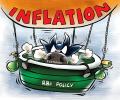
The Reserve Bank on Wednesday projected inflation to come down below the upper threshold level of 6 per cent by March quarter of the current fiscal. RBI Governor Shaktikanta Das said the central bank will keep 'Arjuna's eye' (focus) on the evolving inflation dynamics and will remain 'nimble and flexible' to deal with the price situation. Global commodity prices, including crude oil, have undergone some downward correction, but uncertainty continues to surround the near-term outlook in view of the prolonging geo-political hostilities. Moreover, the resurgence in domestic services sector activity could also lead to price increases, especially as firms pass on input costs.

Eminent economist Arvind Panagariya has said India is on the cusp of returning to a high growth trajectory and voiced confidence that the country will become the world's third-largest economy by 2027-28. Currently, India is the fifth largest economy "so it's another five years.We are already in (the year) 2023. "So 2027-28, India should be the third-largest economy," Panagariya, Columbia University Professor and former Vice Chairman of NITI Aayog, told PTI in an interview in New York.
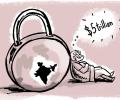
Chief Economic Advisor V Anantha Nageswaran on Thursday expressed hope that the economy will maintain the trend growth rate of 6.5 per cent and above for the rest of the years in the current decade. The economy will close the current fiscal logging in a growth of 6.5-7 per cent, he said, citing the projections of private sector analysts, Reserve Bank of India (RBI) and international agencies like OECD and the IMF. "This appears to be reasonable at this point in time although we will get the data on the fiscal second quarter in a few days, which will give more clarity on these numbers.

India has built up buffers against cyclical difficulties and has ample foreign exchange reserves to withstand pressure on credit worthiness, S&P Global Ratings said on Thursday. Speaking at the India Credit Spotlight 2022 webinar, S&P Sovereign & International Public Finance Ratings director Andrew Wood said the country has a strong external balance sheet and limited external debt, making debt servicing not so expensive. "The country has built up buffers against cyclical difficulties like those, which we are experiencing right now," Wood said.

For the Mizo people, tribal and family identity are important. But so are jobs, farmers' access to markets, roads, and health facilities for a young population where drugs are a big affliction.

Several speakers noted that Budget carried the weight of expectations.

'Investors should ideally consider equity allocations from a medium-to-long term perspective.'

Leading brokerages Nomura and Barclays on said current account deficit, which unexpectedly improved to 4.8 per cent in 2012-13, but still at a historic high, could moderate further this fiscal on slowing gold imports and cheaper commodities.

Ahead of the Union Budget, the banking sector, through the Indian Banks' Association (IBA), has made recommendations to the Union finance ministry on direct tax, including removing Section 194N of the Income Tax Act. According to Section 194N, tax deduction at source (TDS) has to be done if a sum or sums withdrawn in cash by a person in a fiscal year exceed Rs 20 lakh if no income-tax return (ITR) has been filed for the three previous assessment years, and Rs 1 crore if ITRs have been filed in all the three previous assessment years.

The slowdown in corporate revenue growth over the last one year has begun to reflect in India Inc's capital expenditure, or capex. The country's top listed companies are going slow on fresh investment in capacity expansion, in line with a deceleration in their top line growth. The combined fixed assets of the listed companies, excluding banking, finance services and insurance (BFSI) and the government-owned oil & gas firms, were up 10.1 per cent year-on-year (Y-o-Y) during April-September 2023 (H1FY24) - the slowest in 18 months - as against 21.1 per cent Y-o-Y growth in H2FY23 (October 2022-March 2023) and 11.6 per cent growth in the April-September 2022 period (H1FY23).

Throughout 2022, China turned to the PLA as an increasingly capable instrument of Statecraft, strengthening its ability to 'fight and win wars' against a 'strong enemy', points out Ajai Shukla.

Chief Economic Adviser V Anantha Nageswaran on Thursday said cryptocurrencies are akin to 'a world of Caribbean pirates' in the absence of a centralised regulatory authority and are yet to pass the test of a fiat currency. He said that the government is pursuing a 'high-wire balancing act' to ensure that the gains in growth, inflation, and rupee stability of the last four years are not frittered away. He said the recent development in Terra-Luna cryptocurrency, which witnessed a massive meltdown last month, is a 'very important cautionary tale'.

Penalties for non-disclosure or inaccurate disclosure of these details can be severe.

The Indian government and RBI must keep foreign equity investors happy and avoid crushing growth expectations, notes Akash Prakash.

S&P Global Ratings on Tuesday affirmed India's sovereign rating at the lowest investment grade of 'BBB-' for the 14th year in a row with a stable outlook, and said that the country's strong external settings will act as a buffer against financial strains despite elevated government funding needs over the next 24 months. The sovereign credit ratings on India reflect the economy's above-average long-term real GDP growth, sound external profile, and evolving monetary settings, S&P Global Ratings stated. "India's democratic institutions promote policy stability and compromise, and also underpin the ratings. "These strengths are balanced against vulnerabilities stemming from the country's low per capita income and weak fiscal settings, including consistently elevated general government deficits and indebtedness," it said in a statement. S&P Global Ratings has forecast economic activity in India to begin to normalise throughout the remainder of fiscal 2022, resulting in real GDP growth of about 9.5 per cent.

Rating agencies Crisil and Icra on Monday revised down their India growth projections for the current fiscal and the second quarter mainly due to the ripple effect of slowdown in global growth and mixed crop output. Crisil downgraded the India growth forecast by 30 bps to 7 per cent while Icra pegged the economic expansion at 6.5 per cent for the second quarter of FY2022-23. "We have revised down our forecast for real gross domestic product growth to 7 per cent for fiscal 2023 from 7.3 per cent, primarily because of the slowdown in global growth that has started to impact our exports and industrial activity.

With economic activity still to reach pre-pandemic levels, the RBI may slow down the pace of rate hikes until next year to quell soaring inflation while supporting growth, the Asian Development Bank (ADB) says in its latest report. The Manila-based multilateral funding agency has raised the inflation forecast for the current fiscal year ending in March 2023 to 6.7 per cent from its earlier projection of 5.8 per cent. For the next fiscal year too, the forecast has been revised upwards to 5.8 per cent from 5 per cent earlier.

The windfall taxes on domestic crude oil production and fuel exports will generate close to $12 billion (Rs 94,800 crore) for the government in the remainder of the current fiscal while trimming profits of firms such as Reliance Industries Ltd and ONGC, Moody's Investors Service said Tuesday. On July 1, the government imposed windfall gain taxes on the export of petrol, diesel and aviation turbine fuel (ATF), and on the domestic production of crude oil. It has also mandated exporters to meet the requirements of the domestic market first.

The ongoing Hamas-Israel conflict has disrupted India's efforts to gain from a recent fall in crude oil prices. Since Hamas' invasion of southern Israel on October 7, petroleum has become costlier by around $5 per barrel, threatening to stoke prices and impact growth. Brent crude was trading at $89.8 per barrel on October 9 (9.15 pm IST), up over 4 per cent, thwarting India's anticipation of a period of declining oil prices - after the leading global petroleum benchmark declined by around 11 per cent last week.

Reliance Industries Ltd on Friday reported a 27 per cent jump in its September quarter net profit as earnings from the oil and gas business rebounded, and a pick-up in fashion and grocery helped boost retail revenues. The oil-to-retail-to-telecom conglomerate's consolidated net profit of Rs 17,394 crore, or Rs 25.71 per share, in July-September - the second quarter of the current 2023-24 fiscal - was 27.3 per cent higher than Rs 13,656 crore, or Rs 19.92 a share, earning a year back, the company said in a statement. The net profit was also higher quarter-on-quarter compared to Rs 16,011 crore earnings in the preceding three months ended June 30.

The Reserve Bank of India on Thursday opted for a pause second time in a row, maintaining key benchmark policy rate at 6.5 per cent as inflation moderates. The rate increase cycle was paused in April after six consecutive rate hikes aggregating to 250 basis points since May 2022. Announcing the bi-monthly monetary policy, RBI Governor Shaktikanta Das said the Monetary Policy Committee (MPC) unanimously decided to keep the rate unchanged at 6.5 per cent.

The RBI kept interest rates unchanged at 8 per cent as widely expected.

In 2012-13, the Centre managed to cut fiscal deficit to 4.9% of GDP, lower than the Budget revised estimates of 5.2%

Polarisation in the performance of Indian banks will persist as many large public sector banks are still saddled with weak assets, high credit costs, and poor earnings, S&P Global Ratings said on Thursday. It said State Bank of India and leading private sector banks have largely addressed their asset quality challenges, and their profitability is improving more sharply than the banking system. In its Global Banking Outlook-2023 report, S&P said economic recovery is driving credit costs to cyclical low levels and stronger balance sheets and higher demand should boost bank loan growth, but deposit growth will lag.

Every 10 per cent rise in crude oil price will shave off around 0.2 percentage point (pp) from India's GDP growth and widen the current account by 0.3 per cent, says Nomura.
